
Modern construction and demolition projects are increasingly taking place in dense, built-up environments. From city centers and hospitals to transport hubs and occupied commercial buildings, contractors face growing pressure to minimize disruption while maintaining precision and safety.
In these conditions, the choice of cutting method is no longer just about capability, it’s about control, predictability and impact.
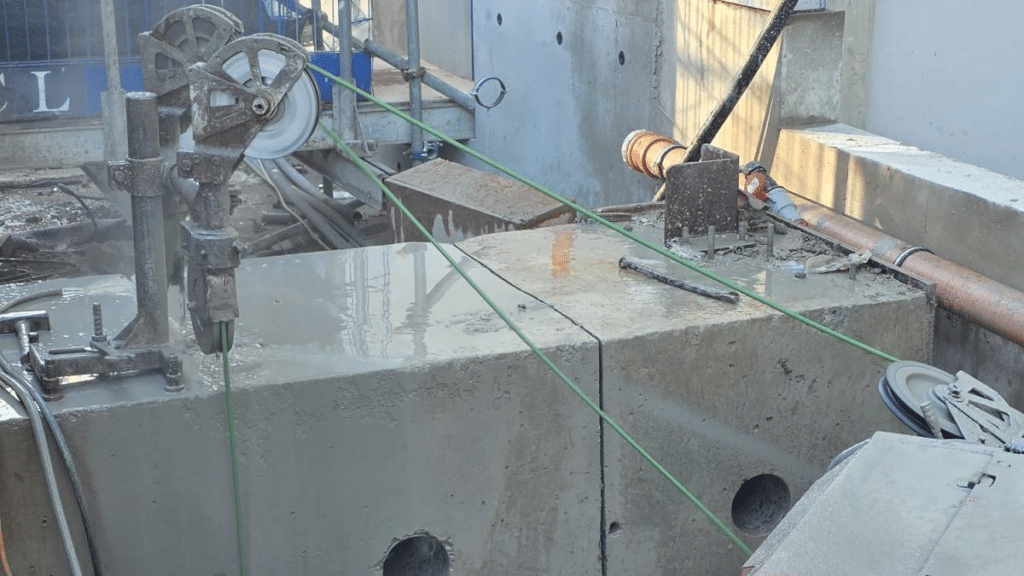
The Challenge of Working in Built-Up Environments
Urban and sensitive sites introduce constraints that are rarely present on open projects, including:
- Strict noise regulations
- Proximity to occupied buildings
- Structural sensitivity of surrounding assets
- Limited working space and access
- Increased health and safety scrutiny
While traditional cutting methods remain effective in less restricted environments, they can introduce challenges in these conditions – particularly around noise, vibration and access.
Meeting Noise Restrictions on Modern Sites
Noise is often one of the biggest limiting factors on urban projects. Excessive sound can disrupt businesses and residents, breach regulations and restrict working hours.
Diamond wire cutting operates with comparatively low noise levels, often allowing work to continue in environments where percussive or heavy mechanical methods would require additional mitigation or restricted hours.
Controlling Vibration and Protecting Structures
Vibration presents a more subtle but equally significant risk. In sensitive structures, it can contribute to microcracking, structural stress, or damage to adjacent assets.
As a low-vibration technique, diamond wire cutting helps reduce these risks making it particularly suited to projects involving structural modifications within or near existing buildings.
Precision In Confined and Complex Spaces
Access is another common constraint. Urban sites often involve restricted working areas, complex geometries, or the need to work around existing infrastructure.
Diamond wire cutting systems are highly adaptable, allowing operators to carry out precise cuts in confined or hard-to-reach locations where traditional methods may be impractical.
Improving Safety in High-Risk Environments
Safety is a critical consideration, especially in occupied or high-traffic areas. Diamond wire cutting supports safer operations through:
- Remote or controlled operation
- Reduced operator exposure to noise, dust and vibration
- Lower physical strain compared to manual methods
This makes it a strong option where safety risks need to be tightly managed.
Where Traditional Methods Fall Short
Traditional cutting techniques can still play an important role in many projects. However, in urban and sensitive environments, their limitations become more pronounced particularly in terms of noise, vibration and flexibility.
Diamond wire cutting offers a more controlled and adaptable approach in these scenarios.
Conclusion
In environments where disruption must be minimized and precision is critical, diamond wire cutting provides a controlled, low-impact solution.
While not always necessary for every project, it is often the preferred choice for contractors working in urban and sensitive settings where noise, vibration and access are key constraints.
For a broader overview of how diamond wire cutting supports reinforced concrete and heavy civil applications, read our main guide to diamond wire cutting.
You may also find these related articles useful: when large concrete sections demand diamond wire cutting, diamond wire cutting for reinforced concrete in heavy civil construction, and how diamond wire and concrete sawing efficiency changes by application.
