
Introduction
In most concrete cutting operations, method selection is relatively straightforward. Wall saws, floor saws and track-mounted systems handle the majority of reinforced concrete sections efficiently, delivering predictable cutting speed and clean separation.
However, as reinforced concrete sections increase in size, the decision-making process begins to change. Cutting speed alone is no longer the primary factor. Instead, contractors must consider how well a method performs when scale, access and structural complexity begin to overlap, particularly when working with heavily reinforced structures.
For many heavy civil and infrastructure projects, this transition often occurs when concrete cross-sections approach or exceed approximately 500 mm × 500 mm. At this point, the practical limitations of conventional cutting methods begin to emerge.
At this point, the practical limitations of conventional cutting methods begin to emerge. In these scenarios, more advanced approaches such as diamond wire cutting become necessary, as outlined in our guide to concrete cutting methods.
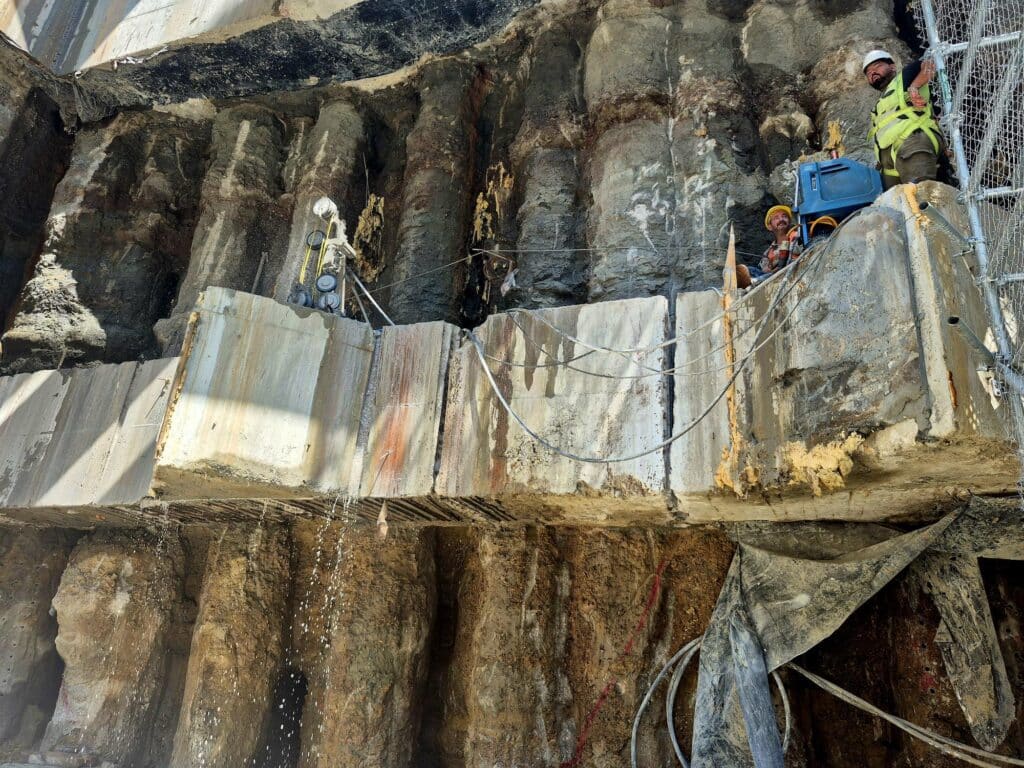
The Practical Size Threshold Contractors Encounter
Conventional saw cutting remains highly effective within its intended range. However, as section size increases, contractors consistently encounter a threshold where cutting performance and site logistics begin to shift.
Once sections approach roughly 500 mm × 500 mm, deeper blade engagement, increased reinforcement exposure and longer continuous cuts begin to combine. What were once isolated challenges start to overlap, reducing cutting efficiency and increasing wear on equipment.
At the same time, flexibility in saw positioning becomes more limited. This makes it harder to maintain optimal cutting conditions, particularly in complex or heavily reinforced structures.
When Traditional Concrete Cutting Methods Become Inefficient
Wall saws and track-mounted systems are designed for precision and speed within defined limits. Beyond those limits, contractors often experience diminishing returns rather than outright failure.
Cutting speeds slow as resistance increases, particularly in deeper sections with dense reinforcement. The need for repositioning becomes more frequent, requiring additional setup time and interrupting workflow. Blade wear accelerates, especially where reinforcement is consistently encountered throughout the cut.
In some cases, contractors must introduce secondary methods such as stitch drilling to complete the cut, adding further time and labor. Material variability can also play a role, with differences in aggregate hardness and reinforcement density affecting consistency and predictability.
How Section Size Changes More Than Just the Cut
As concrete sections grow larger, contractors are no longer planning only the cut itself. They are planning the entire removal process around the structure.
This includes determining how the element will be segmented, how each section will be lifted and how structural stability will be maintained throughout the operation. Access and positioning constraints also become more significant, particularly on complex or confined sites.
At this scale, cutting becomes part of a broader logistical and engineering challenge rather than a standalone task.
Selecting the right cutting method early in the planning stage can significantly improve efficiency, reduce delays and minimize risk on complex projects.
Diaquip supports contractors during early-stage planning to help identify the most effective cutting approach.
Access Constraints and Complex Cutting Environments
Larger structural elements are often located in areas where access is limited or restricted. This can make it difficult to position conventional cutting equipment in the optimal location.
Diamond wire sawing provides a level of flexibility that blade-based systems cannot always achieve. Because the wire can be threaded around or through the structure, it allows cuts to be completed in locations where traditional methods may not be practical.
This includes plunge wire sawing, where cuts are performed without the ability to fully wrap the wire around the structure. In these scenarios, wire sawing enables access and completion of cuts that would otherwise be extremely difficult using conventional techniques.
When Section Size Changes the Economics of the Cut
Once reinforced concrete sections exceed approximately 500 mm × 500 mm, contractors often notice a shift in how cutting productivity behaves.
The issue is not simply depth. It is the way multiple constraints begin to overlap. Increased resistance, longer cutting durations, more complex setup requirements and higher labor input all begin to combine.
Selecting the right cutting method early in the planning stage can significantly improve efficiency, reduce delays and minimize risk on complex projects.
Diaquip supports contractors during early-stage planning to help identify the most effective cutting approach.
At smaller scales, these factors can be managed without significant impact. At larger scales, their combined effect begins to influence program duration and overall cost. This is why the 500 mm × 500 mm threshold is so useful in practice – it marks the point where conventional methods often become less efficient and alternative approaches need to be considered.
Why Diamond Wire Becomes More Effective at Scale
Diamond wire cutting addresses many of the limitations associated with circular blades. Rather than being constrained by cutting depth, the wire can be configured around the structure, allowing the cut to continue through large cross-sections without the same physical restrictions.
As section size increases, this results in more consistent cutting performance and reduces the need for repeated repositioning. Larger cuts can often be completed as a continuous process, improving workflow and reducing interruptions.
This makes wire sawing particularly well suited to large structural elements such as bridge components, foundations, retaining walls and marine infrastructure. The key advantage is not simply speed, but reliability and consistency as scale increases.
Planning Concrete Removal Around Structural Scale
In large-scale removal projects, cutting strategy must align closely with how the structure will be removed from site.
Contractors need to determine how sections will be divided, how they will be lifted and in what sequence removal will take place. The ability to control section size is critical to ensuring safe and efficient handling.
Wire sawing provides flexibility in defining cut locations, helping contractors create segments that align with lifting capacity and removal planning.
When Not to Use Wire Sawing
Despite its advantages, wire sawing is not always the most appropriate solution. Conventional cutting methods may still be more efficient for smaller sections, shallow cuts or repetitive tasks where speed is the primary requirement and access is straightforward.
Effective method selection depends on matching the cutting approach to the scale and constraints of the project.
Key Takeaways
For smaller reinforced concrete sections, efficiency is largely determined by cutting speed. As section size increases, efficiency becomes dependent on how well a method performs under multiple overlapping constraints.
Once cross-sections exceed approximately 500 mm × 500 mm, contractors often reach a point where wire sawing becomes the more practical and predictable solution. Recognizing this transition early allows for better planning, improved efficiency and reduced project risk.
Project Planning Support
For project-specific advice on cutting methodology and equipment selection, contact the Diaquip team.
